SNAPSHOTS

Tuesday, May 8, 2007

What issues are important to you as a voter?

Interviews by Jodel Pierre P. Ampil, Keila Marii C. Chavez, and Edgar B. Concepcion Jr.


“Platforms, because you have to know where they stand. Also, the automated voting thing, because it is there [where] you will get the credibility of your vote. Nuisance candidates [are also an issue] because they are irritating. It’s because some of them are obviously political strategies to mess the elections.” – Ma. Teresa Gromia (III BS MCT)

“I guess the platforms of the candidates and their competence and passion to serve the people.” – Cherilyn Sy (II BS ME)

“Women’s issues, children’s rights, education.” – Margarita Orendain, Ph.D., Chair, Department of English

Siguro yung political background ng candidates. Like Manny Pacquiao, wala siyang political background. Importante yun kasi nawawala yung red tape sa trabaho. So if may political background, tingin ko mas competent sila for their position.” – Phillip Andrew Ruby (II BS ME)

“[Ang] importante sa akin [ay] kung ano ba yung, kunwari re-electionist, ano ba yung performance niya nung nakaraan niyang [termino]?” – Ma. Theresa Villanueva, Head, Filipiniana Section of the Rizal Library

“For me, I believe that the two issues that should be focused on are the political killings, how each candidate actually responds to the problem of political killings today and how each candidate also responds to the problems with the environment and how they can make businesses more eco-friendly to give a better environment to the Philippines.” – John Jeremiah Rimando (III AB Eco)

“First of all, yung platform, tapos kailangan makita mo yung dedication nila to help the people, hindi lang alam mong gusto lang nilang makapasok sa politics. Personally, ayoko ng artista.” – Bianca Marie Agustin (II BS ME)

“Issues as a voter? If there’s actually someone to vote for. Because I really am not interested in voting for anybody I don’t believe in. So in these elections, I don’t think I’m going to vote… Although I can vote. I’m registered. There’s no one to vote for so that’s a big, big issue. Why vote if there’s no one to vote for?” – Conrado Nicolas Atienza (II AB Comm)

“I suppose yung economic issue and corruption in the government. We have the top position as the most corrupt country in Asia. And whatever they say about the increase in [Gross National Product (GNP)]… pwede mong doktorin yun. At education issues, which ha[ve] never been addressed since the time of Martial Law.” – Name withheld, Associate Professor, Department of Theology

Gusto ko para sa eleksyon ‘yung walang dayaan. Parehas kung sino talaga ang dapat manalo… At saka dapat piliin ang talagang mapapagkatiwalaan ng bayan.” – Ruben Yanson, security guard

Kelangan mo yung ano magagawa niya sa kabataan. Second, kung ano yung sa economy kasi tumataas na ‘yung economy. Okay na yun sa tingin ko… So paano ime-maintain at paano yun mate-take advantage ng mga businessmen and government officials. Third, yung sa culture. Sa akin kasi, mas important yung pagpapanatili ng culture ng Pilipino at ‘di ‘pag-ano sa Western thoughts.” – Al Agassiz dela Torre (III BSM AMF)

Dapat meron silang care for the taxpayers dahil [taxpayers] yung nagdudusa. Pati na rin ‘yung education and their street smartness or their common sense, how they live the real life.” – Claudia Camille Fernandez (II BS ME)

“[Sana] mapayapa ‘yung election sa Lunes tapos… mawala yung vote-buying and then maging matalino sa pagpili ng ibobotong tao para iluklok sa posisyon bilang senador.” – Rogelio Alabat, Ateneo maintenance, Office of Administrative Services (OAS)

“Well, [one of] the issues that are important to me as a voter is … especially focused on education because education tackles mostly … [how] … the children of today, not just children but adolescents and adults today, can evolve in terms of intellectual ability and the skills that can be honed in order to lift up the situation of the country.” – Mario Lorenzo Cuyegkeng (II BS HS)

WHAT ISSUES ARE IMPORTANT TO YOU AS A VOTER? Comment and share your views with the rest of the Ateneo community!

Guidelines on Voting Wisely: PART II

by Rizsa Rose S. Baer (IV AB PoS)
Head, Issue and Policy Analysis Cluster
Council of Organizations of the Ateneo (COA
)


1. Vote right.
Vote for the person who is right for the position, not just because they're a relative or an acquaintance. Elections may be, in part, a popularity contest, but let it not stop there. Personally, I am more weary of the flashy candidates than the quiet ones. Silent water runs deep (although we have to remember that politicians can NOT be forever silent).

2. Information is key.
Gather and study the candidates' credentials well. Be aware of the bias of the source and know how to balance the two sides. Listen to jingles and campaign ads but KNOW that it is possibly only half true. Don't take any info at face value. Corroborating evidence usually never fails.

3. Be sensitive.
Action speaks louder than words. There are always documents or statistics or studies that candidates can use to back their claims to greatness but be aware and conscious. When in power did they do something? If they did, what did they do? How did their constituents benefit? Flashy projects may be just that, flashy. What was the trade-off that happened? The most beautiful park for a lot of starving and uneducated children?
Or another simple telling factor: if they can't follow the simple rules that the Comelec has about posters and whatnots, will you risk putting them in a position where they can ensure no law touches them?

4. Discuss.
Discuss who you'll vote for with your family or your friends. Ask the opinion of the people you share the same interests and views or principles with and share your ideas with them as well. Chances are, you not only get to have an intelligent conversation with your peers but you will also gain their respect for having such well-informed opinions (you might even have a complete senatorial slate without breaking a sweat, to boot). Just don't forget that, in the end, it is YOU who will still make the final decision.

5. Don't be a cynic.
A healthy dose of cynicism is always good, but if you always look at the glass half-empty, it will be. Nobody's perfect but a good question to ask is, who will most likely try to be?

6. Pursue accountability.
The problem with citizens is that they don't hold their incumbents accountable. This apathy allows the rotten politicians to get re-elected and therefore adds more fuel to the corruption and inefficiency in the government. We have to remember that the election is the FIRST step, not the last. Keep track of the candidates that you voted. Before writing down a name, be sure that in the end you will not be ashamed to show everyone who you entrusted your future to.

7. Be an active stakeholder.
Politics affects everyone. Regardless of your main interest, whether it is in arts or science or business, you are a Filipino and whatever happens to the Philippines WILL reflect on you. I don't want to sound crude but most of the candidates are, frankly, old. They will not be the ones who will suffer the consequences of their actions, we are. The youth will be the ones who will bear the full brunt of the outcome of this election. So guard your vote. Vote wisely and report any anomalies or fraud that you see.

Monday, May 7, 2007

Young voters praise, criticize Senate bets in debate

by Paterno R. Esmaquel II


THE BUZZ outside Irwin Theater on April 25 was proof enough—more than the senatorial debate there earlier that day—that the youth vote is a thinking vote.

The debate, titled “DB8 2007,” aimed to educate first-time voters as a response to Chief Justice Reynato Puno’s call for the youth to “make a decisive difference on the outcome of the coming elections.”

The senatoriables who attended the debate were Ang Kapatiran’s Martin Bautista, Jesus Paredes, and Adrian Sison, and the Genuine Opposition’s (GO) Alan Cayetano and Sonia Roco. Team Unity (TU) candidates were a no-show.

The event was organized by the Jaycees International Senate, the University of the Philippines Debate Society (UPDS), and the Ateneo Debate Society (ADS).

Knowing candidates

Lilia Seelin, former Jaycees president and one of the organizers, was glad that the young audience had their own opinions on the debate, which touched on issues like globalization and birth control.

The topics even found their way into the students’ conversations after the event.

Leloy Claudio (AB Comm ’07), a former student debater, said that he wanted to react the most to Paredes’s opinion on birth control. Running under a platform of “God-fearing leadership,” Paredes said that Ang Kapatiran is against artificial family planning, and goes for the Church-endorsed natural methods.

Claudio, the valedictorian of his graduating class, said that in a secular context, such a Church view cannot be imposed. “I was pretty upset at the way Kapatiran dealt with family planning, although I have to admit that they’re still a better alternative compared to most of the politicians out there.”

Meanwhile, students from the University of St. Paul praised Cayetano for his take on political dynasties. Cayetano answered a question from Inquirer columnist Rina Jimenez-David, one of the moderators, who noted that two Cayetanos—Alan and his sister, Pia—will be in the Senate if Alan wins.

“There’s a thing about having public service in your blood,” Cayetano said. “The question is whether the public official serves the country or only himself.”

UP education

Roco, a teacher by profession, was asked by UP student debater Maria Theresa Grajo, another moderator, if the State should continue funding tertiary education.

Roco answered, “Subsidies should not stand forever; people should be able to stand on their own.” While noting that UP’s funding is different from that of other state colleges and universities—UP gets a bigger budget, for example—Roco said that the Senate should look more deeply into how UP is being managed.

Addressing the budget problem, Bautista called for the repeal of the Automatic Appropriations Act, which automatically allots a large chunk of the national budget for debt payment.

“We put 1% to health care, 11% to education, 28% to interest payments alone. I find this totally immoral,” he said.

Team Unity’s absence

Notable was how the Ang Kapatiran trio, who have performed poorly in surveys, caught the students’ attention.

“After the debate, I got to know Ang Kapatiran,” said Linette Arreola, a junior from UP-Diliman. “They would certainly have a spot in my ballot.”

Clark Cue (IV BS ME), president of the Council of Organizations of the Ateneo (COA), had a similar opinion, noting that he didn’t even consider the Kapatiran candidates in the mock elections before the debate. “After hearing them, I think I would consider the three of them. Maganda ang mga sinabi nila (Their speeches were good)."

On the other hand, many were disappointed with the absence of administration bets.

Seelin explained that whereas with GO candidates, the problem was only with conflicting schedules, “with Team Unity, we really had a problem getting them.”

Claudio added, “I think it just shows the lack of transparency or accountability of this government to the most critical sector of society, which is the youth.”

with reports from Ryan Edward L. Chua and Lionel D. Lopez-Dee

Party-lists

Source: http://www.comelec.gov.ph

CERTIFIED LIST OF SECTORAL PARTIES/ORGANIZATIONS/POLITICAL PARTIES/COALITIONS PARTICIPATING IN THE PARTY-LIST SYSTEM FOR THE MAY 14, 2007 ELECTIONS

No.

NAME

ACRONYM

1.

1- UNITED TRANSPORT KOALISYON

1-UTAK

2.

AA-KASOSYO PARTY

AA-KASOSYO

3.

AANGAT TAYO

AT

4.

ABAKADA GURO formerly Advocates and Adherents of Social Justice for School Teachers and Allied Workers

ABAKADA

5.

ABANSE!PINAY

ABANSE! PINAY

6.

ABANTE ILONGGO, INC

ABA ILONGGO

7.

ABONO

ABONO

8.

ACTION FOR DEMOCRACY AND DEVELOPMENT FOR THE TRIBAL PEOPLE

ADD-TRIBAL

9.

ACTION FOR DYNAMIC DEVELOPMENT, INC.

ADD

10.

ADVOCACY FOR TEACHER EMPOWERMENT THROUGH ACTION, COOPERATION, AND HARMONY TOWARDS EDUCATIONAL REFORMS, INC

A TEACHER

11.

ADVOCATES FOR SPECIAL CHILDREN AND THE HANDICAPPED MOVEMENT*

ASAHAN MO

12.

AGBIAG!TIMPUYOG ILOCANO, INC

AGBIAG

13.

AGING FILIPINO ORGANIZATION, INC

AGING PINOY

14.

AGRICULTURAL SECTOR ALLIANCE OF THE PHILIPPINES, INC

AGAP

15.

AHON PINOY

AHON

16.

AHONBAYAN**

AHONBAYAN

17.

AKBAY PINOY OFW-NATIONAL, INC

APO!

18.

AKBAYAN!CITIZEN'S ACTION PARTY

AKBAYAN

19.

AKSYON SAMBAYANAN

AKSA

20.

ALAGAD

ALAGAD

21.

ALAY SA BAYAN NG MALAYANG PROPESYONAL AT REPORMANG KALAKAL

ABAY PARAK

22.

ALLIANCE FOR BARANGAY CONCERNS

ABC

23.

ALLIANCE FOR NATIONALISM AND DEMOCRACY

ANAD

24.

ALLIANCE OF ASSOCIATIONS OF ACCREDITED WORKERS IN THE WATER SECTOR, INC.

AAWAS

25.

ALLIANCE OF NEO-CONSERVATIVES

ANC

26.

ALLIANCE OF PEOPLE'S ORGANIZATIONS

APO

27.

ALLIANCE OF RURAL CONCERNS

ARC

28.

ALLIANCE OF VENDORS AND TRADERS OF THE PHILIPPINES

VENDORS

29.

ALLIANCE OF VOLUNTEER EDUCATORS

AVE

30.

ALLIANCE TRANSPORT SECTOR

ATS

31.

ALYANSA NG MAMAMAYANG NAGHIHIRAP

ALMANA

32.

ALYANSA NG MAY KAPANSANANG PINOY

AKAPIN

33.

ALYANSA NG MGA GRUPONG HALIGI NG AGHAM AT TEKNOLOHIYA PARA SA MAMAMAYAN, INC

AGHAM

34.

ALYANSA NG SAMBAYANAN PARA SA PAGBABABAGO

ASAP

35.

ALYANSANG BAYANIHAN NG MAGSASAKA, MANGGAGAWANG BUKID AT MANGINGISDA-ADHIKAIN AT KILUSAN NG ORDINARYONG TAO

ABA-AKO

36.

AN WARAY

AN WARAY

37.

ANAK MINDANO

AMIN

38.

ANAK PAWIS***

ANAKPAWIS

39.

ANG BAGONG BAYAN NA NAGTATAGUYOD NG DEMOKRATIKONG IDEOLOGIYA AT LAYUNIN

BANDILA

40.

ANG GALING PINOY

AG

41.

ANG LABAN NG INDIGINONG FILIPINO

ALIF

42.

ANG SAMAHAN NG MGA MANGANGALAKAL PARA SA IKAUUNLAD NG LOKAL NA EKONOMIYA (A SMILE) formerly Samahan ng mga Mangangalakal Para sa Ikauunlad ng Lokal na Ekonomiya

A SMILE

43.

ANGAT ANTAS KABUHAYAN PILIPINO MOVEMENT

AANGAT KA PILIPINO

44.

ANGAT ATING KABUHAYAN PILIPINAS, INC

ANAK

45.

ARTS BUSINESS AND SCIENCE PROFESSIONALS

ABS

46.

ASOSASYON NG MGA MALILIIT NA NEGOSYANTENG GUMAGANAP

AMANG

47.

ASSALAM BANGSAMORO PEOPLE'S PARTY

ASSALAM

48.

ASSOCIATION OF ADMINISTRATORS, PROFESSIONALS AND SENIORS

AAPS

49.

ASSOCIATION OF PHILIPPINE ELECTRIC COOPERATIVES

APEC

50.

BABAE PARA SA KAUNLARAN

BABAE KA

51.

BAGO NATIONAL CULTURAL SOCIETY OF THE PHILIPPINES

BAGO

52.

BAGONG ALYANSANG TAGAPAGTAGUYOD NG ADHIKAING SAMBAYANAN

BATAS

53.

BAGONG TAO MOVEMENT

BTM

54.

BAHANDI SA KAUMAHAN UG KADAGATAN

BAHANDI

55.

BARANGAY ASSOCIATION FOR NATIONAL ADVANCEMENT OF TRANSPARENCY

BANAT

56.

BAYAN MUNA***

BAYAN MUNA

57.

BIGKIS PINOY MOVEMENT

BIGKIS

58.

BIYAHENG PINOY

BP

59.

BIYAYANG BUKID

BIYAYANG BUKID

60.

BUHAY HAYAAN YUMABONG

BUHAY

61.

CITIZENS BATTLE AGAINST CORRUPTION

CIBAC

62.

COALITION OF ASSOCIATIONS OF SENIOR CITIZENS IN THE PHILIPPINES, INC

SENIOR CITIZENS

63.

COCOFED-PHILIPPINE COCONUT PRODUCERS FEDERATION, INC.

COCOFED

64.

CONFEDERATION OF GRAINS RETAILERS ASSOCIATION OF THE PHILIPPINES

GRECON

65.

COOPERATIVE-NATCO NETWORK PARTY

COOP-NATCCO

66.

DEMOCRATIC INDEPENDENT WORKERS ASSOCIATION, INC

DIWA

67.

FILIPINOS FOR PEACE, JUSTICE AND PROGRESS MOVEMENT ****

PFJPM

68.

GABRIELA WOMEN'S PARTY ***

GABRIELA

69.

HANAY NG APING PINOY

HAPI

70.

KABATAAN

KABATAAN

71.

KABUKLURAN NG MGA KABABAIHANG FILIPINA SA TIMOG KATAGALUGAN

BUKLOD FILIPINA

72.

KALAHI- ADVOCATES FOR OVERSEAS FILIPINOS

KALAHI

73.

KAPATIRAN NG MGA NAKULONG NA WALANG SALA

KAKUSA

74.

KASANGGA SA KAUNLARAN, INC

ANG KASANGGA

75.

KOALISYON NG KATUTUBONG SAMAHAN NG PILIPINAS

KASAPI

76.

LUZON FARMERS PARTY

BUTIL

77.

NOVELTY ENTREPRENEURSHIP AND LIVELIHOOD FOR FOOD, INC

NELFFI

78.

PARENTS ENABLING PARENTS COALITION PARTY *****

PEP

79.

PARTIDO NG MANGGAGAWA

PM

80.

PEOPLE'S MOVEMENT AGAINST POVERTY

PMAP

81.

PWERSA NG BAYANING ATLETA

PBA

82.

SANDIGANG MARALITA

SM

83.

SANLAKAS

SANLAKAS

84.

SEAMAN'S PARTY INC.

SPI

85.

SUARA BANGSAMORO

SUARA

86.

SULONG! BARANGAY MOVEMENT

SB

87.

THE TRUE MARCOS LOYALIST (FOR GOD, COUNTRY AND PEOPLE) ASSOCIATION OF THE PHILIPPINES, INC

BANTAY

88.

TRADE UNION CONGRESS PARTY

TUCP

89.

UNION OF THE MASSES FOR DEMOCRACY AND JUSTICE ******

UMDJ

90.

UNITED MOVEMENT AGAINST DRUGS

UNI-MAD

91.

VETERANS FREEDOM PARTY

VFP

92.

YOU AGAINST CORRUPTION AND POVERTY

YACAP

93.

YOUTH LEAGUE FOR PEACE ADVANCEMENT

LYPAD

* Subject to pending case docketed as SPA 07-012.

** Subject to pending case docketed as SPA 07-021.

****Subject to pending case docketed as SPP 07-013

*** Subject to pending case docketed as SPP 07-015 &SPP 07-016

*****Subject to pending case docketed as SPP 07-010

****** Subject to pending case docketed as SPP 06-065 (PL)


Sunday, May 6, 2007

Why we should still care

by Leloy Claudio
Ateneo Debate Society (ADS)
Batch 2007 Valedictorian

I dislike a lot of things in Ang Kapatiran’s platform and a lot of what they stand for. For one, I think their conservative insistence on imposing Natural Family Planning on everyone is abhorrent – a blanket imposition of questionable religious beliefs (many Christian theologians approve of artificial family planning) to a secular public. I’m also not very impressed with the way they talk about issues. They moralize instead of analyze and abstract instead of engage. To be fair, there are issues they talk about with precision and clarity (i.e. when Dr. Martin Bautista talks about our debt problem), but, by and large, they have the tendency to sound like the trapos they love to criticize. In a debate which my organization, the Ateneo Debate Society, hosted, I saw the Kapatiran members get outshined by the intelligence and precision of Rep. Alan Cayetano (someone people should definitely vote for).

Despite all my misgivings, however, I don’t think it would be wrong to vote for Kapatiran. In fact, they might actually be good for the Senate. They seem honest, well-intentioned, and selfless. They’ve achieved a bare minimum that people like Mike Defensor, Butch Pichay, Richard Gomez, Tito Sotto, or Chavit Singson haven’t.

Voting for people based on a bare minimum standard is something we do in a country like the Philippines. This is simply because, as everybody knows, most politicians suck. One of the reasons why it’s so hard to focus on platforms is because, half the time, we’re trying to make sure the candidate we’re considering is not a jueteng lord.

Certainly, there’s something wrong. And we get a greater sense of how wrong things are when we compare ourselves to other countries. Many times, I entertain a sense of colonial mentality and compare the Philippine political system to the one in the U.S. In America, there are two parties, and it is easy to differentiate them based on issues. The Democrats are more socially liberal and more predisposed to a welfare/nanny economics, while the Republicans are more socially conservative and tend to love the free market more. If one were to place Kapatiran in the American political spectrum, they’d probably be Republican. And if I were an American, I’d be a card-carrying Democrat and would never dream of voting in Republicans. But, since I’m in the Philippines, I’m willing to vote for people on the other side of the political spectrum simply because they’re honest.

No wonder many of us become jaded and decide to withdraw. We don’t pick up the papers, we don’t lobby, we don’t vote, etc. We just stop caring. Or, we care, but we care in other ways. At the end of the day, however, I think our frustration with the way things are should not get in the way of the bigger picture. National politics is important, and we cannot give up on it no matter how bad it gets.

We have the power to change things, so it is incumbent upon us to respond. The system is not bad because there are stupid poor voters who don’t know what’s best for the country. This bigotry must be ended in favor a view that recognizes our (the middle and upper classes) complicity in the creation and maintenance of this system. Upon recognizing this complicity, we should also recognize that it is within our capacity to reverse what we have done. Trapos are trapos because our own families, schools, fraternities, etc. have bred them. If we seek culture changes in these institutions and if we ourselves imbibe these changes, the system will give. Trapos are also trapos because we have let them get away with pillaging the country, and, at times, even benefited from their pilferage. If we are vigilant against them and if we communicate this vigilance, they will eventually give. Trapos are trapos because some of us opt to join their ranks. If we are vigilant about ourselves, we will also give.

Change can happen, and change is already happening. People like our own Danton Remoto, parties like Kapatiran, and civil society networks like Volunteers for Clean Elections (VforCE) are evidence of this. They are part of a broader process of reworking the system.

The change in this system is happening through a large-scale culture change. Culture changes, however, accrue gradually and one can neither directly see nor measure these changes. This is very different from the wonderful community work which a lot of us have been used to. Building houses for poor people, for instance, is immediate gratification because you get to see how communities get uplifted rather quickly. Changing the political system, however, is a different ball game.

But this doesn’t mean it won’t have effects. A more transparent national government, for example, would be one which people could more easily hold accountable for acts of corruption (this is why the ADS, for example, will lobby for a freedom of information act). And, as many of you know, the Philippines would be a lot richer if our money didn’t go to our “public servants.” To rephrase this in the form of a challenge: people are stealing your money, are we just going to sit there and let them?

Hopefully we don’t. So what can you do? Allow me to close with a couple of concrete suggestions:
1) Vote.
2) Inform yourselves about candidates and tell people about those who you think should make it and should not make it to office. As I mentioned, I’m a Cayetano fan (please write his complete name, Alan Cayetano, on the ballot).
3) Find ways to guard yours and other people’s votes. Join VforCE (http://vforce.multiply.com).
4) Know about political issues even when it’s not election time. Just because it’s not voting time, doesn’t mean you can’t lobby.
5) Demand that television networks educate people about political issues through writing them. Watch and support the smart ones; boycott and complain about the dumb ones.
6) Love your country. Okay, that’s not concrete, but it’s what’s most important.

Ateneo heads Namfrel QC quick count

by Ayee D. Macaraig INSTEAD OF eating out with friends or partying, Justin Victor de la Cruz (BS Mgt ’07) will be tabulating votes on his birthday, May 14, which is also national elections day.

De la Cruz is one of over 1,000 volunteers for Bantay Bilang, an election quick count that the Loyola Schools (LS) has volunteered to head.

Bantay Bilang is the Operation Quick Count of the National Citizens’ Movement for Free Elections (Namfrel) for the Quezon City (QC) chapter.

Accredited by the Commission on Elections (Comelec), Namfrel will conduct the quick count for the May 14 elections.

To check against cheating

The quick count aims to be an alternative to the official Comelec vote count and is therefore a check against the manipulation of results.


The tabulation of votes will be conducted non-stop from May 14 to 20 at the Manuel V. Pangilinan Center for Student Leadership (MVP-CSL) and at Faura Hall.


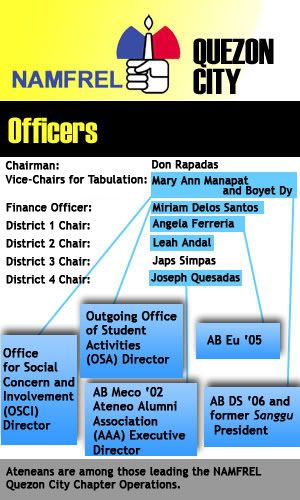
Sanggunian ng mga Mag-aaral (Sanggu) President Karl Satinitigan (IV BS LM) said that the Ateneo has been volunteering to help in the QC quick count since 1987.

The chairpersons of this year’s quick count are outgoing Office of Student Activities (OSA) Director Miriam Delos Santos, former Sanggu President Boyet Dy (AB DS ’06), and Office for Social Concern and Involvement (OSCI) Director Mary Ann Manapat.


As of press time, the chairpersons could not be reached for comment.
Restoring belief in elections


Satinitigan and former Sanggu Vice President Pao Abarcar (AB Eco-H ’07) are also leaders of the quick count.


“[The quick count] aims to restore belief and hope in the [electoral] system. It combats that powerlessness we often feel and shows us that we can help make [the electoral system] better,” said Abarcar.

Satinitigan said that the Ateneo volunteered for the quick count to serve the QC community and to help ensure that the country’s democracy-in-progress works.

Despite the enormity of the task, volunteer de la Cruz is looking forward to helping out in the quick count. “I think May 14, [my birthday], will be a lot more special and meaningful by giving my efforts and my time to our country. It’s worth it.”


“[These] elections [are] our elections. No matter how we hate [the candidates] or this government or the politics in this country, it is our government and our politics and our country,” Satinitigan added.

Namfrel QC Chairman Don Rapadas said that since the Ateneo is an institution that is very much aware of social issues and realities, “it’s very easy for [it] to take up a good cause. It’s not something that you need to hard sell.”


“One person, one vote”

Benjamin Tolosa Jr., Ph.D., associate professor of the Department of Political Science, emphasized the importance of the quick count.

“One person, one vote. That’s something that’s sacred that you have to protect and therefore you have to make sure that it’s counted and counted right,” said Tolosa.

The actual counting of individual ballots is not part of the quick count, as this is done in the precinct level by Comelec-mandated teachers. Rather, the quick count involves checking if the votes are correctly tallied and if the number of votes equals the number of actual voters.

To do this, volunteers will use the sixth copy of the election return (ER), a document containing the number of registered and actual voters in a precinct and the number of votes cast in that precinct.

Rapadas said that even if the Namfrel quick count is unofficial, it is still credible because the ER is an official document.

Going beyond elections

Tolosa said that the quick count must be seen as part of a larger effort that the Ateneo is involved in—the nationwide movement called 1 Million Volunteers for Clean Elections (VforCE).

He added that about 85% of Filipinos vote but their participation must go beyond the elections to attain long-term political and social change.

Such change is one of the goals of VforCE together with protecting the integrity of the elections, and fighting fraud and violence.

The VforCE projects tackle voters’ education (Pinoy Voters’ Academy), campaign finance checking (Bantay Kampanya), poll watching (Bantay Presinto), canvass monitoring (Bantay Canvass), and an accountability mechanism (Bantay Pangako).

The Ateneo is involved in VforCE through the Sanggu and LS orgs, Simbahang Lingkod ng Bayan (SLB), the Ateneo Professional Schools (APS), and the Ateneo Human Rights Center (AHRC).

with reports from Stephanie O. Chan and Karl Louie B. Fajardo

Attendance in quick count GA higher than expected

by Ojie L. Ocampo


“OVERWHELMING” WAS how Don Rapadas, Quezon City (QC) chairman of the National Citizens’ Movement for Free Elections (Namfrel), described the volunteer turnout for the first quick count general assembly (GA).

The 680 volunteers who attended the GA on April 16 filled all of the seats in Escaler Hall, with some people having to sit on the floor and outside the hall.

The GA briefed volunteers on the quick count of the QC votes, a project that the Loyola Schools (LS) heads in cooperation with Namfrel to check the accuracy of the Commission on Elections (Comelec) vote count.


The quick count, also known as Bantay Bilang, will be held from May 14 to 20 at the Manuel V. Pangilinan Center for Student Leadership (MVP-CSL) and at Faura Hall.

Joanna Beatrice Gomez (III BS Psy), volunteer support head for the quick count, said that the GA attendance was double the expected 250 to 300 people.

“Stepping up”

Gomez said that she is grateful to the volunteers for stepping up. She added that it is enlightening to know that the youth, the future of the country, still have a drive for volunteering.

Rapadas also said, “I think [that the turnout] is a manifestation that [the volunteers] still have hope and that they still believe that they can still make a difference, and make their vote make a difference in the coming elections.”

Having the chance to make a difference is the main reason Gomez cited to explain the GA attendance. “I think the thought that nandiyan iyong opportunity na makakatulong ka (there is an opportunity to help) to the bigger nation is very enticing.”

Alexandra Filipina Orosa (IV AB IS) said that even if she is not a registered voter, she volunteered for the quick count to help in some way.

Eryn Gayle De Leon (II BS ES), another volunteer, said that the quick count is a step to ending the corruption and dishonesty in the country’s electoral system. “It especially empowers the youth with the ability to change the society which they constantly lambast.”

De Leon also said that the efforts of the Sanggunian ng mga Mag-aaral (Sanggu) to organize the quick count have been successful. “It’s great to see a socially active student council.”

The Sanggu started organizing election-related projects last school year with its “Reg2Vote” campaign, which encouraged students to register to vote in the elections. Reg2Vote won the Most Outstanding Project Award in the 2007 LS Awards for Leadership and Service (LSALS).


“Still not enough”

Gomez said that as of press time, there are over 1,000 volunteers listed in the quick count’s database, 661 of which already have shifts. She also said that the volunteers are mostly Ateneans.

Rapadas and Gomez added that despite the good attendance in the GA, the volunteer turnout is still not enough to reach the target 2,736 tabulation volunteers. This number is needed if each volunteer is to have only one shift.

“[But] I know that Ateneans are very eager [and] zealous about these things so I’m sure they will commit to more than one shift [to] make up for the lack in number,” said Rapadas.

When asked regarding probable reasons for just an average response, Gomez said that vacation and summer classes hinder people from volunteering.

Rapadas, meanwhile, said that practicality is a factor affecting volunteerism for the entire QC chapter. “Some people have become more practical as to choose kung ano iyong may bayad (whatever it is that has pay).”

Both Gomez and Rapadas agreed that the existence of other organizations divides the volunteer base and therefore lessens the potential quick count volunteers.


Rallying for more

“[Volunteers must] see the work that they are doing as something that will contribute to the history of Ateneo—that once in 2007, we have made sure that we value so much our right to suffrage, and truth and honesty,” said Rapadas.

People can still volunteer for the quick count by sending their contact information and desired shifts to bantaybilang@yahoo.com or by joining bantaybilang_home@yahoogroups.com. Gomez said that walk-in volunteers are also welcome.

with a report from Yeni C. Raboca