SNAPSHOTS

Sunday, May 6, 2007

Why we should still care

by Leloy Claudio
Ateneo Debate Society (ADS)
Batch 2007 Valedictorian

I dislike a lot of things in Ang Kapatiran’s platform and a lot of what they stand for. For one, I think their conservative insistence on imposing Natural Family Planning on everyone is abhorrent – a blanket imposition of questionable religious beliefs (many Christian theologians approve of artificial family planning) to a secular public. I’m also not very impressed with the way they talk about issues. They moralize instead of analyze and abstract instead of engage. To be fair, there are issues they talk about with precision and clarity (i.e. when Dr. Martin Bautista talks about our debt problem), but, by and large, they have the tendency to sound like the trapos they love to criticize. In a debate which my organization, the Ateneo Debate Society, hosted, I saw the Kapatiran members get outshined by the intelligence and precision of Rep. Alan Cayetano (someone people should definitely vote for).

Despite all my misgivings, however, I don’t think it would be wrong to vote for Kapatiran. In fact, they might actually be good for the Senate. They seem honest, well-intentioned, and selfless. They’ve achieved a bare minimum that people like Mike Defensor, Butch Pichay, Richard Gomez, Tito Sotto, or Chavit Singson haven’t.

Voting for people based on a bare minimum standard is something we do in a country like the Philippines. This is simply because, as everybody knows, most politicians suck. One of the reasons why it’s so hard to focus on platforms is because, half the time, we’re trying to make sure the candidate we’re considering is not a jueteng lord.

Certainly, there’s something wrong. And we get a greater sense of how wrong things are when we compare ourselves to other countries. Many times, I entertain a sense of colonial mentality and compare the Philippine political system to the one in the U.S. In America, there are two parties, and it is easy to differentiate them based on issues. The Democrats are more socially liberal and more predisposed to a welfare/nanny economics, while the Republicans are more socially conservative and tend to love the free market more. If one were to place Kapatiran in the American political spectrum, they’d probably be Republican. And if I were an American, I’d be a card-carrying Democrat and would never dream of voting in Republicans. But, since I’m in the Philippines, I’m willing to vote for people on the other side of the political spectrum simply because they’re honest.

No wonder many of us become jaded and decide to withdraw. We don’t pick up the papers, we don’t lobby, we don’t vote, etc. We just stop caring. Or, we care, but we care in other ways. At the end of the day, however, I think our frustration with the way things are should not get in the way of the bigger picture. National politics is important, and we cannot give up on it no matter how bad it gets.

We have the power to change things, so it is incumbent upon us to respond. The system is not bad because there are stupid poor voters who don’t know what’s best for the country. This bigotry must be ended in favor a view that recognizes our (the middle and upper classes) complicity in the creation and maintenance of this system. Upon recognizing this complicity, we should also recognize that it is within our capacity to reverse what we have done. Trapos are trapos because our own families, schools, fraternities, etc. have bred them. If we seek culture changes in these institutions and if we ourselves imbibe these changes, the system will give. Trapos are also trapos because we have let them get away with pillaging the country, and, at times, even benefited from their pilferage. If we are vigilant against them and if we communicate this vigilance, they will eventually give. Trapos are trapos because some of us opt to join their ranks. If we are vigilant about ourselves, we will also give.

Change can happen, and change is already happening. People like our own Danton Remoto, parties like Kapatiran, and civil society networks like Volunteers for Clean Elections (VforCE) are evidence of this. They are part of a broader process of reworking the system.

The change in this system is happening through a large-scale culture change. Culture changes, however, accrue gradually and one can neither directly see nor measure these changes. This is very different from the wonderful community work which a lot of us have been used to. Building houses for poor people, for instance, is immediate gratification because you get to see how communities get uplifted rather quickly. Changing the political system, however, is a different ball game.

But this doesn’t mean it won’t have effects. A more transparent national government, for example, would be one which people could more easily hold accountable for acts of corruption (this is why the ADS, for example, will lobby for a freedom of information act). And, as many of you know, the Philippines would be a lot richer if our money didn’t go to our “public servants.” To rephrase this in the form of a challenge: people are stealing your money, are we just going to sit there and let them?

Hopefully we don’t. So what can you do? Allow me to close with a couple of concrete suggestions:
1) Vote.
2) Inform yourselves about candidates and tell people about those who you think should make it and should not make it to office. As I mentioned, I’m a Cayetano fan (please write his complete name, Alan Cayetano, on the ballot).
3) Find ways to guard yours and other people’s votes. Join VforCE (http://vforce.multiply.com).
4) Know about political issues even when it’s not election time. Just because it’s not voting time, doesn’t mean you can’t lobby.
5) Demand that television networks educate people about political issues through writing them. Watch and support the smart ones; boycott and complain about the dumb ones.
6) Love your country. Okay, that’s not concrete, but it’s what’s most important.

Ateneo heads Namfrel QC quick count

by Ayee D. Macaraig INSTEAD OF eating out with friends or partying, Justin Victor de la Cruz (BS Mgt ’07) will be tabulating votes on his birthday, May 14, which is also national elections day.

De la Cruz is one of over 1,000 volunteers for Bantay Bilang, an election quick count that the Loyola Schools (LS) has volunteered to head.

Bantay Bilang is the Operation Quick Count of the National Citizens’ Movement for Free Elections (Namfrel) for the Quezon City (QC) chapter.

Accredited by the Commission on Elections (Comelec), Namfrel will conduct the quick count for the May 14 elections.

To check against cheating

The quick count aims to be an alternative to the official Comelec vote count and is therefore a check against the manipulation of results.


The tabulation of votes will be conducted non-stop from May 14 to 20 at the Manuel V. Pangilinan Center for Student Leadership (MVP-CSL) and at Faura Hall.


Sanggunian ng mga Mag-aaral (Sanggu) President Karl Satinitigan (IV BS LM) said that the Ateneo has been volunteering to help in the QC quick count since 1987.

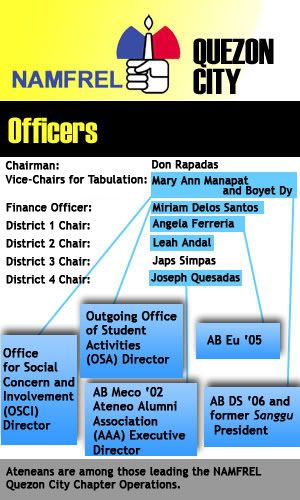
The chairpersons of this year’s quick count are outgoing Office of Student Activities (OSA) Director Miriam Delos Santos, former Sanggu President Boyet Dy (AB DS ’06), and Office for Social Concern and Involvement (OSCI) Director Mary Ann Manapat.


As of press time, the chairpersons could not be reached for comment.
Restoring belief in elections


Satinitigan and former Sanggu Vice President Pao Abarcar (AB Eco-H ’07) are also leaders of the quick count.


“[The quick count] aims to restore belief and hope in the [electoral] system. It combats that powerlessness we often feel and shows us that we can help make [the electoral system] better,” said Abarcar.

Satinitigan said that the Ateneo volunteered for the quick count to serve the QC community and to help ensure that the country’s democracy-in-progress works.

Despite the enormity of the task, volunteer de la Cruz is looking forward to helping out in the quick count. “I think May 14, [my birthday], will be a lot more special and meaningful by giving my efforts and my time to our country. It’s worth it.”


“[These] elections [are] our elections. No matter how we hate [the candidates] or this government or the politics in this country, it is our government and our politics and our country,” Satinitigan added.

Namfrel QC Chairman Don Rapadas said that since the Ateneo is an institution that is very much aware of social issues and realities, “it’s very easy for [it] to take up a good cause. It’s not something that you need to hard sell.”


“One person, one vote”

Benjamin Tolosa Jr., Ph.D., associate professor of the Department of Political Science, emphasized the importance of the quick count.

“One person, one vote. That’s something that’s sacred that you have to protect and therefore you have to make sure that it’s counted and counted right,” said Tolosa.

The actual counting of individual ballots is not part of the quick count, as this is done in the precinct level by Comelec-mandated teachers. Rather, the quick count involves checking if the votes are correctly tallied and if the number of votes equals the number of actual voters.

To do this, volunteers will use the sixth copy of the election return (ER), a document containing the number of registered and actual voters in a precinct and the number of votes cast in that precinct.

Rapadas said that even if the Namfrel quick count is unofficial, it is still credible because the ER is an official document.

Going beyond elections

Tolosa said that the quick count must be seen as part of a larger effort that the Ateneo is involved in—the nationwide movement called 1 Million Volunteers for Clean Elections (VforCE).

He added that about 85% of Filipinos vote but their participation must go beyond the elections to attain long-term political and social change.

Such change is one of the goals of VforCE together with protecting the integrity of the elections, and fighting fraud and violence.

The VforCE projects tackle voters’ education (Pinoy Voters’ Academy), campaign finance checking (Bantay Kampanya), poll watching (Bantay Presinto), canvass monitoring (Bantay Canvass), and an accountability mechanism (Bantay Pangako).

The Ateneo is involved in VforCE through the Sanggu and LS orgs, Simbahang Lingkod ng Bayan (SLB), the Ateneo Professional Schools (APS), and the Ateneo Human Rights Center (AHRC).

with reports from Stephanie O. Chan and Karl Louie B. Fajardo

Attendance in quick count GA higher than expected

by Ojie L. Ocampo


“OVERWHELMING” WAS how Don Rapadas, Quezon City (QC) chairman of the National Citizens’ Movement for Free Elections (Namfrel), described the volunteer turnout for the first quick count general assembly (GA).

The 680 volunteers who attended the GA on April 16 filled all of the seats in Escaler Hall, with some people having to sit on the floor and outside the hall.

The GA briefed volunteers on the quick count of the QC votes, a project that the Loyola Schools (LS) heads in cooperation with Namfrel to check the accuracy of the Commission on Elections (Comelec) vote count.


The quick count, also known as Bantay Bilang, will be held from May 14 to 20 at the Manuel V. Pangilinan Center for Student Leadership (MVP-CSL) and at Faura Hall.

Joanna Beatrice Gomez (III BS Psy), volunteer support head for the quick count, said that the GA attendance was double the expected 250 to 300 people.

“Stepping up”

Gomez said that she is grateful to the volunteers for stepping up. She added that it is enlightening to know that the youth, the future of the country, still have a drive for volunteering.

Rapadas also said, “I think [that the turnout] is a manifestation that [the volunteers] still have hope and that they still believe that they can still make a difference, and make their vote make a difference in the coming elections.”

Having the chance to make a difference is the main reason Gomez cited to explain the GA attendance. “I think the thought that nandiyan iyong opportunity na makakatulong ka (there is an opportunity to help) to the bigger nation is very enticing.”

Alexandra Filipina Orosa (IV AB IS) said that even if she is not a registered voter, she volunteered for the quick count to help in some way.

Eryn Gayle De Leon (II BS ES), another volunteer, said that the quick count is a step to ending the corruption and dishonesty in the country’s electoral system. “It especially empowers the youth with the ability to change the society which they constantly lambast.”

De Leon also said that the efforts of the Sanggunian ng mga Mag-aaral (Sanggu) to organize the quick count have been successful. “It’s great to see a socially active student council.”

The Sanggu started organizing election-related projects last school year with its “Reg2Vote” campaign, which encouraged students to register to vote in the elections. Reg2Vote won the Most Outstanding Project Award in the 2007 LS Awards for Leadership and Service (LSALS).


“Still not enough”

Gomez said that as of press time, there are over 1,000 volunteers listed in the quick count’s database, 661 of which already have shifts. She also said that the volunteers are mostly Ateneans.

Rapadas and Gomez added that despite the good attendance in the GA, the volunteer turnout is still not enough to reach the target 2,736 tabulation volunteers. This number is needed if each volunteer is to have only one shift.

“[But] I know that Ateneans are very eager [and] zealous about these things so I’m sure they will commit to more than one shift [to] make up for the lack in number,” said Rapadas.

When asked regarding probable reasons for just an average response, Gomez said that vacation and summer classes hinder people from volunteering.

Rapadas, meanwhile, said that practicality is a factor affecting volunteerism for the entire QC chapter. “Some people have become more practical as to choose kung ano iyong may bayad (whatever it is that has pay).”

Both Gomez and Rapadas agreed that the existence of other organizations divides the volunteer base and therefore lessens the potential quick count volunteers.


Rallying for more

“[Volunteers must] see the work that they are doing as something that will contribute to the history of Ateneo—that once in 2007, we have made sure that we value so much our right to suffrage, and truth and honesty,” said Rapadas.

People can still volunteer for the quick count by sending their contact information and desired shifts to bantaybilang@yahoo.com or by joining bantaybilang_home@yahoogroups.com. Gomez said that walk-in volunteers are also welcome.

with a report from Yeni C. Raboca

Bantay Bilang volunteers train for tasks

by Stephanie O. ChanTO ORIENT volunteers and to remind them about the significance of their tasks, training sessions for Bantay Bilang, an election quick count headed by the Loyola Schools (LS), were held on April 21 and 22 at Escaler Hall.

Quick count Volunteer Training Head Aaron Palabyab (AB Comm ’07) conducted the training sessions with quick count Chairperson Boyet Dy (AB DS ’06).


Palabyab is a former 4th year Sanggunian ng mga Mag-aaral (Sanggu) executive officer for the School of Social Sciences (SOSS) Board, while Dy is a former Sanggu president.


Bantay Bilang is the National Citizens’ Movement for Free Elections (Namfrel) Operation Quick Count for the Quezon City (QC) chapter. Now with over 1,000 volunteers, this project aims to conduct a quick count of QC votes to validate the Commission on Elections (Comelec) vote count.

Over 2,000 volunteers needed


Namfrel QC Chairman Don Rapadas said that QC volunteers have an enormous task.


As of January 2007, QC has one of the country’s largest voting populations, which is 1,043,229.

For the quick count, 2,736 volunteers are needed to man the non-stop operations from May 14 to 20 at the Manuel V. Pangilinan Center for Student Leadership (MVP-CSL) and at Faura Hall.


Each day will have six shifts, with each shift consisting of four hours. There should be 76 people per shift to maintain operations.


How the quick count works


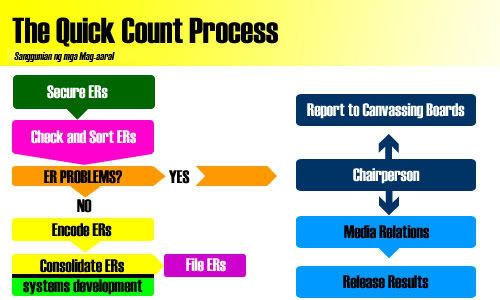
In the training sessions, Palabyab explained the tasks that volunteers may sign up for: checkers, runners, readers, encoders, and filers.


The process begins when the administration staff receives the sixth copy of the election return (ER), the official document containing the number of registered and actual voters in a precinct, and the number of votes cast in that precinct.


At the Colayco Pavilion, the admin staff will sort and process the ERs. These will then be given to runners, who will hand the ERs to the storage area at the second floor of MVP-CSL.


Palabyab said that checkers will then make sure that the information in the ERs is complete, especially the number of registered and actual voters. The tallies of votes at the end of the ERs also have to match the stick figures.

ERs with incomplete or incorrect information will be set aside and the admin staff will contact the precinct in question to clarify the matter. Otherwise, checkers will give them to runners, who will bring them to the tabulating center in Faura Hall.

At Faura, readers will dictate the contents of the ERs to the encoder, who will input the data into a program designed to tabulate and automatically consolidate the votes.

The runners will then bring the ERs to the post-storage area at the second floor of MVP-CSL. Filers will do final checks and then file the ERs according to district.


Meanwhile, the system administrator will send the updated results to the secure site of Namfrel National every half-hour or every hour by uploading a special file with all the consolidated results.


Namfrel National will then do the final consolidation and prepare the reports for the media, political parties and candidates.


“Helpful training”

For volunteer Ma. Larissa Rachelle Espiritu (II BS Mgt), the training was helpful. “I was able to understand the different aspects of the system that I am sure will help me execute the [task] I signed up [for] properly.”

Palabyab said that only 325 volunteers attended the training sessions. The rest of the volunteers would have to go through walk-in training.

Palabyab added that volunteers must be alert, responsible, and focused. “While [the work] will be fun because [volunteers] get to work with their friends while doing something for the country, they shouldn’t forget that what they’re doing is actually serious business.”

with a report from Nikko Carlo A. Tolentino

GLIMPSES SPECIAL EDITION: Ateneo's Involvement in VforCE Projects

by Jan Lane G. Canseko

SLB and Sanggu contribute to voters’ education

FROM MAY 1 to 14, Simbahang Lingkod ng Bayan’s (SLB) Bantay Call Center project will be open to answer election-related inquiries. Callers anywhere from Luzon, Visayas, and Mindanao can dial 10-149 from a PLDT landline to talk to a tele-educator for free.

Geared towards people who cannot read or who have limited access to the Internet, the two-week activity aims to help people make educated votes. It will also be made available to OFWs.

For those who have easy access to the Internet, various institutions like the De La Salle University (DLSU) and the Makati Business Club (MBC) have provided Web sites that present information on candidates’ profiles.

With the importance of political education among voters, especially the youth, candidates’ forums were also held. The Union of Catholic Student Councils (UCSC) and the Sanggunian ng mga Mag-aaral (Sanggu), under the leadership of former President Luis Abad (AB Eco-H ’07), sponsored a senatorial candidates’ forum at St. Scholastica’s College (SSC) last March 9.


Ateneo orgs handle VforCE communications


WITH THE elections fast approaching, several organizations have pushed for political consciousness and volunteerism through communications and resource-generation.

For the Ateneo effort, the Ateneo Debate Society (ADS), the Harvard Project for Asian and International Relations (HPAIR), and the Association of Communication Majors (AComm) are leading the communications work. Batch 2007 valedictorian Leloy Claudio (AB Comm ’07) and former HPAIR President Sharmila Parmanand (AB PoS ’07) are heading this initiative.

Parmanand said that they are working for the visibility of VForCE in mainstream media to reach a bigger audience. In partnership with advertising company Campaigns and Grey, they conceptualized a media campaign which is set to be broadcasted soon.

The Makati Business Club (MBC), meanwhile, is handling logistical support for the Democracy Fund. Key leaders of One Voice, a non-partisan movement calling for social and electoral reforms, are also undertaking the overall effort in coordination.


AHRC and Law School Student Council to help monitor canvassing

TO ENSURE the effectiveness of election monitoring, the group 1 Million Volunteers for Clean Elections (VforCE) has launched three projects: Poll Watch 2007 or Bantay Presinto, Operation Quick Count or Bantay Bilang, and canvass monitoring or Bantay Canvass.

The Parish Pastoral Council for Responsible Voting (PPCRV) will lead the poll watch, the National Citizens’ Movement for Free Elections (Namfrel) will conduct the quick count, and the Legal Network for Truthful Elections (LENTE) is in charge of canvass monitoring.

LENTE is a nationwide network of lawyers, law students, and paralegals. The Ateneo Human Rights Center (AHRC) and the Ateneo Law School (ALS) Student Council are part of LENTE. Atty. Carlos Medina Jr., executive director of the AHRC, is also a LENTE co-convenor.

Bantay Presinto, meanwhile, aims to ensure clean and fair elections by designating trained poll-watchers to monitor counting activities, while Bantay Canvass will watch over the aggregation of votes at the municipal, city and provincial levels and respond to calls for legal assistance.


Ateneo groups help communities develop agenda

TO HEIGHTEN political awareness and responsibility among Filipinos, the group 1 Million Volunteers for Clean Elections (VforCE) developed Pinoy Voters’ Academy. VforCE also came up with Bantay Pangako, a project that allows communities to set their agenda, choose their candidates, and hold these candidates accountable. It also involves monitoring the fulfillment of campaign promises after the elections.

Bantay Pangako is concerned with direct community development work, which involves various social involvement offices such as former members of the now-defunct Socially-oriented Organizations of the Ateneo (SOA), Gawad Kalinga (GK), and the Office for Social Concern and Involvement (OSCI).

Department of Economics Lecturer Philip Tuano and Benjamin Barretto, special project assistant for development of the Ateneo School of Government (ASG), are coordinating Bantay Pangako.

with a report from Xianne S. Arcangel

What do you look for in a candidate?

Interviews by Martin Dante L. del Rosario, Katrina B. Paredes, and Margaret Michelle C. Tan


“Platform, credibility, experience. Kasama na rin diyan ang history, past projects, past bills passed, at iba pa.” – Miguel Lope Inumerable (III BS CS)

“Wit and intelligence. Gusto ko rin alam niya kung ano yung gusto niyang mangyari.– Anne Precious Kristine Rellin (III BS MCT)

Sana at least graduate ng college, tapos siyempre responsible tsaka committed. Basta yung may pinag-aralan, hindi ako go ‘dun sa mga nagsasabing kahit walang pinag-aralan may abilidad, iba pa rin yung may pinag-aralan.”Julie Rose Bagasbas, Staff, Office of Student Activities (OSA)

“Integrity. I think that if a candidate has credibility, then everything else will follow.” – Maria Michelle Michiko Soriano (II BS Mgt)

Pare-parehas naman eh, kahit sino naman maupo ganun pa rin eh, walang pagbabago. Wala na, bahala na lang kung sinong manalo, ganun rin eh.”Adrian Asuncion, Staff, Ateneo Multi-Purpose Cooperative (AMPC)

“The candidate must have integrity, must be a hard worker, has concern for the people, and is also honest and just.” – Erwin John Aquino (III BS Bio)

“If I think they’re smart, then I’m gonna [sic] vote for them.” – Jose David Jorge Yulo (II BS Mgt)

’Yung hindi plastic. Pinapanood ko ‘yung mga forums on TV. ‘Yung marunong sumagot. ‘Yung hindi [marunong sumagot], definitely ‘di na ‘yun. I’m not very particular with parties, more on individual candidates talaga. I also visit their websites to check them out.” – Earl Keh, Faculty Member, Department of Quantitative Methods and Information Technology, John Gokongwei School of Management (JGSOM)

“I look for a good platform and credibility. [Dapat] okay ‘yung background—he didn’t do anything wrong or [he must have] no record of doing something scandalous.” – Jessica Jean Kristine Cocabo (II BS MAC)

“His credibility. I check out their podcasts, interviews, past projects, etcetera. Through [these], I will know in a way if he’s willing and capable of fulfilling his platform.” – Ruby Criselda Domingo (IV BS Mgt)

Ayaw ko sa kandidato na hindi marunong sumagot ng simpleng tanong ukol sa kanilang pagkakandidato, at sa pagsagot nila ay hindi nila naiisip na walang katuturan o may kabuluhan sa pagiging sensitive sa mga nakikinig. Ayaw ko din ang kandidato na hindi tugma ang mga goals sa pagiging senador. Sa ibang salita ay dapat sa ibang posisyon sila tumakbo.– Nina Isabella Niguidula (III BS MCT)

’Yung maka-tao, maka-Diyos, at matulungin.” – Loreto Quinit, Security Guard, Manuel V. Pangilinan Center for Student Leadership (MVP-CSL)

“That’s not a simple question. The candidate must have devotion, truth, honesty, and selflessness.” – Simone Josefina Banawa (III AB MEco)

WHAT DO YOU LOOK FOR IN A CANDIDATE? Comment and share your views with the rest of the Ateneo community!

Guidelines on Voting Wisely: PART I

by Department of Political Science Chair Alma Maria O. Salvador (as told to Hannah S. Varilla)

The following guidelines are divided into two, normative and operational. Normative guidelines are those that have to do with one’s understanding of governance in the nation. Operational guidelines deal with the actual procedure of voting.

Normative guidelines
(1-2 pertains to senatorial and congress votes, 3 to party list votes)
1. The voter must be informed of the importance of why they need to vote. This can be done through their personal undertaking of educating themselves about the why’s and how’s of voting, and why they SHOULD vote. It is their responsibility to gain knowledge of the importance of suffrage and at the most, have a “sense of their right to vote.” This makes for a better voter.

2. It isn’t enough to know who you are voting, what their platforms are, and getting acquainted with them merely through news or election specials in websites and internet forums. It is better to gauge their capabilities through seeing them in action. This can be done through watching the ANC debate as it gives an idea of how the candidates carry themselves and defend their supposed platforms as they are interrogated by the community.

There are three levels of exposure to the candidates. One would be the news. Another would be the interactive debates or interviews, through channel specials or talk shows. Last would be through joining a campaign in particular, or giving the time to be exposed to their campaign activities. An example would be the barangay assemblies headed by party lists and weekly reports on the elections in Marikina.

3. The best way to go about picking the right party lists is to be observant. Once again, it isn’t enough to form conclusive opinions through data merely from their platforms and motherhood statements. It is presumed that one should gauge with a good sense of political character or on how similar the party list’s actuations are to what they say. It is good to pick up clues from their interviews with the media and assess their platform for oneself. Whether they are disenfranchised or interests groups, we have to distinguish for ourselves their real interests.

Operative guidelines
4. For senatorial elections, one has to come [to the precinct] with at least 12 names. One cannot leave blanks because others might place their own votes on the blanks. The vote is subject to tampering – those who are influential in the precincts are usually the ones whose bias and rules are followed.

As for party lists:

5. For choosing party lists, one needs to ask oneself, “how long have they been there?” Have they been able to make drastic changes for the interests they advocated properly? A little handy research and background information will do.

Party lists comprise of at least 6% or around 300 votes. It would be better to maximize the seats provided for party list representatives if we allowed for the usage of these allotted 50 seats for all the party lists. Instead of giving a mere 6% total support for only dominant party lists, it would be good to make use of the other 2% vote for those with strong advocacies. A variety of votes wouldn’t hurt the effective utilization of party list initiatives.